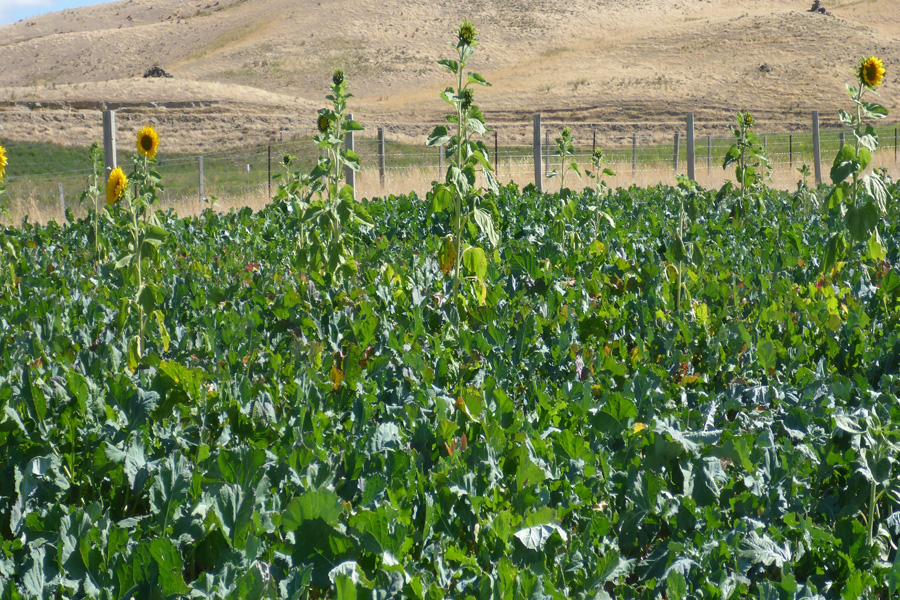
Soil conditioner Zeba performs in dry land crops, winning over The Shannons family in Ida Valley, Central Otago.
Zeba - optimising irrigation, saving dry land crops
As we know, Mid Canterbury gets dry. Really dry. But Ida Valley, Central Otago, takes that up another notch.
There, the Shannon family, sisters Jo and Vicki, are relishing their new challenge, having moved from the North Island. They are also always looking for ways to improve their farm’s performance and get a better return. The flat, very dry area, like most of the region, is at the mercy of the elements with very hot summers and literally freezing winters. Ida Valley is just 35 km from Ranfurly, the town credited by the Alexander Turnbull Library with New Zealand’s lowest ever temperature at minus 25.6, back in 1903.
With the farm the Shannons own, and a bit of extra land leased, Jo and Vicki have a substantial 500 ha of country that’s fairly tough by anyone’s estimation. The family run Perendales as the main mob, with a terminal mob of Perendale ewes crossed with Hampshire and Texel rams, along with South Devon cattle. Having enough feed for the animals is critical and Jo and Vicki have both open minds and eyes when it comes to finding high-performing, cost-effective solutions. Jo says the family use mixed pasture in some paddocks, in part to maximise stock feed but also to use plants with root systems that will break up the soil’s hard, shallow pan.
The Shannons took part in a trial of corn starch-based, super absorbent, Zeba from sustainable agricultural solutions provider UPL NZ Ltd. and were won over. “It’s an amazing product.” Jo says.
Boosting crop establishment
Zeba stores water, then releases it is through natural transfer processes when plants need it. Each Zeba granule holds up to 400 times its own weight in water. A high cation exchange capacity means Zeba is able to positively interact with soil nutrients. It also keeps both water and nutrients where the plant roots need them most, so crop growth is maximised, and growth checks minimised.
Initially, 5 ha were trialled on the property. 3 ha treated and 2 ha untreated. Jo said they could definitely pick the difference. The Shannons then extended their use of Zeba and Jo reckons they’ve been repaid for their confidence.
“We’d recommend it to anyone. It worked and gave plants a chance to get established. Without it, we just wouldn’t have the crops we have now.” Jo says they planted summer crops in October to fatten lambs. Thanks in part to Zeba, the feed lasted to April. “We’ll use it again.”
Holding moisture in reserve
UPL NZ Otago Southland Regional Manager Tom McDonald says the product can decrease the amount of water needed for irrigation – providing greater yields for less cost when rainfall is a limiting factor. “Basically, Zeba helps address a whole lot of concerns around the environment and water use and availability.”
Tom says while relatively new to New Zealand, Zeba has performed well in arid areas of countries including Australia, South Africa, and India. And, he says, the Shannon’s experience and other New Zealand data is compelling. “With increasing climate uncertainty, Zeba is a product that’s in the right place at the right time.”
Zeba activates when rain falls, or irrigation is applied, and has the capability to hold that moisture in reserve. “It increases soil’s nutrient and water holding capacity and it is easy to apply, down the spout, at sowing. You could see it as an insurance policy. Much like the way you’d choose to use treated seed over untreated. It gives you that extra bit of certainty.”
As it’s biodegradable, Zeba leaves no residues behind. Tom says Zeba will recharge when there is additional moisture before eventually breaking down. “It recharges with extra rain or irrigation, but performance will diminish in 3-4 months.” Zeba also offers a direct contribution to soil aeration and bulk density, which in turn is the ideal environment for root and beneficial soil microbe development.
Good fit for forage, cereals and vegetable crops
Tom sounds a note of caution that Zeba is not all things to all paddocks or all farming systems. “Where Zeba especially comes into its own is when you’re looking at crop establishment, particularly for high-value crops where you only really get once chance – like lucerne.” He says the product is also a good fit for brassicas, cereals, and fodder beet.
“We’ve also had impressive results in the establishment of kale, following a crop of cereal on a property other than the Shannons. You can see a real difference between the part of the paddock where Zeba had been used and the successful kale establishment. The other part of the paddock is basically just weeds.”
Tom says the reduction of soil degradation and water conservation are cornerstones of how UPL is working to help farmers and growers towards a more sustainable agricultural system. “It’s what drives us. And Zeba is a perfect example of how that’s applied - reducing agriculture’s water footprint, optimising yields, and keeping costs down.”